

bad hollywood
girl-on-girl and how I never stopped loving Britney Spears

It was a chilly morning in April, and I was carrying a bag of shit.
One of my many cat sitting clients, a woman I have never met, with a penthouse apartment in Prospect Heights, was driving me nuts. I had dropped in on her gray tabby Keiko, some weeks earlier and she never tipped me. This time, she booked with me again for spring break, only to raise an issue with my $25 an hour rate. Leave it to rich people to be so goddamn cheap. Having endured public transport to get from one part of Brooklyn to another, I was feeling behind schedule for the day. Ahead of me were eight hours at my actual job, plus more cat sitting stops that evening. Turning off of her street on foot, I still hadn’t found a receptacle for Keiko’s ‘business.’
It was in this frantic state that I listened to the last chapters of The Woman in Me by Britney Spears. Given my age, my background in performing and my high tolerance for celebrity gossip, you might not be surprised to learn that I could not get enough of Britney’s music as a child. On long car rides I played Britney’s Dance Beat on my Gameboy Advance. My first MP3 player was loaded with songs from Britney’s Greatest Hits: My Prerogative. In the nascent years of Youtube, I watched her music videos on repeat. By the time I left the third grade, I was already fascinated with tabloid magazines, Entertainment Tonight and all E! News programming. Stories about Britney and her exploits were ubiquitous. People, US Weekly, even Rolling Stone ran endless salacious pieces about the Princess of Pop and my other fallen heroes, Lindsay Lohan and Paris Hilton. I largely ignored those stories in favor of the magazines’ style sections (‘Who Wore It Best,’ anyone?) but Britney was there.
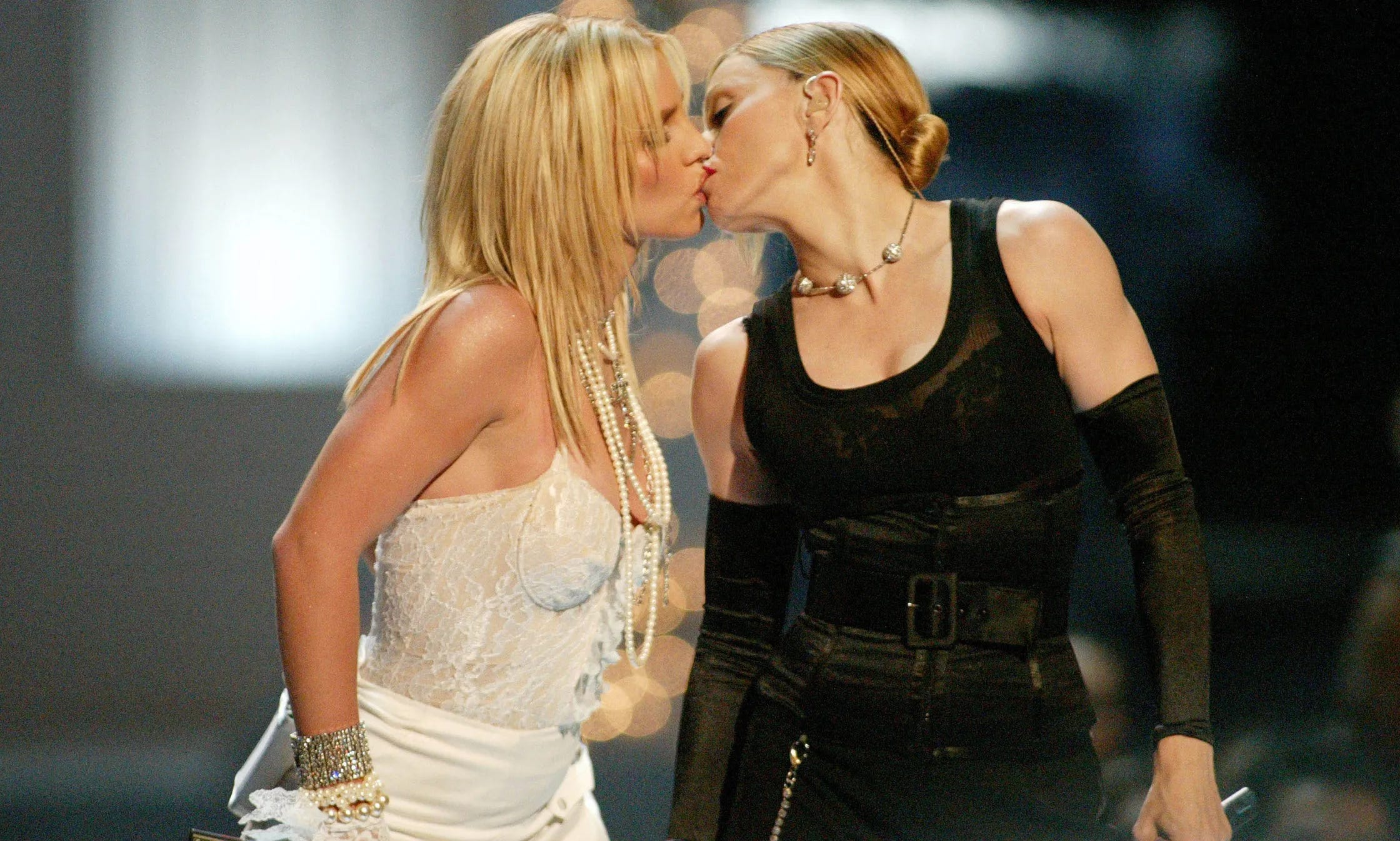
Hey, remember the 2003 MTV Video Music Awards? My memories of Britney as a ‘bad girl’ began to take shape right at this moment, you’ll recall the one I’m talking about. At six, I would have been too young to watch the program in real time, but the image reverberated.
In the award show’s opening act, a 22 year-old Britney Spears and Christina Aguilera, whose professional rivalry was already playing out in the press, are both in the role of brides-to-be, singing a campy cover of ‘Like a Virgin,’ when Madonna emerges at the altar as their groom. What was rehearsed as an air kiss turns into a real kiss between Britney and Madonna onstage, and then Madonna kisses Christina, and then Missy Elliott pops out! In The Woman in Me, Britney recalls this change as her own impulsive idea, ‘should I just go for it?’ Absolute legend.
These insights were, for me, the most compelling aspects of Spears’ memoir. I loved revisiting famous moments from her own perspective. Prior to reading, I was fuzzy on the details of Spears’ conservatorship and suddenly wanted to revisit every second of her illustrious career. The Woman in Me, was her biggest formal address to the world after the conservatorship ended in 2021.
The Woman in Me recounts Britney Spears’ rise to stardom, beginning in Kentwood, Louisiana. Her father, Jamie Spears, was an alcoholic whose debts had accumulated by the time Britney left home, and his marriage to Britney’s mother was a tumultuous one. Both parents were later implicated in the financial abuse against her. After a decade of performing, Spears signed a deal with Jive Records, working with some of the most prominent figures in the music industry. At 17, her debut album, …Baby One More Time exploded onto the pop charts. From 1999 to 2006, Britney was unstoppable— five world tours, four albums, a feature film, endless television appearances, the aforementioned Gameboy game—it’s actually impossible to overstate just how much of a presence Britney Spears had in popular culture, because she fucking made it. Before the days of virality, Britney sold out arenas; her name filled the headlines, and she dominated the charts. And then, well, you know what happened next, don’t you, reader? Don’t you know what always happens?
Next week, Sophie Gilbert’s book Girl on Girl: How Pop Culture Turned a Generation of Women Against Themselves hits shelves. Early reviews for the book identify ‘…Baby One More Time,’ Britney’s debut single, as the death knell for third-wave feminism. This was the inflection point, “when riot grrrl feminism collapsed into a regressive period of hyper-objectification, sexualization and infantilization.” That was the 2000’s I knew and loved.
I’m willing to withhold judgement of Gilbert’s analysis before reading, of course, but when it comes to Britney Spears, I’m cautious. On the subject of infantilization, for example, the record label wanted the ‘…Baby One More Time’ video to feature Spears in costume as a futuristic astronaut. They presented mockups to her of her dressed as something akin to the Pink Power Ranger. It was Britney herself who pushed to have the video take place in a high school. She recalls, “[their idea] didn’t resonate with me, and I had a feeling my audience wouldn’t relate to it, either. I told the executives at the label that I thought people would want to see my friends and me sitting at school, bored, and then as soon as the bell rang, boom—we’d start dancing.”
What to do with this information? What is the line between sexual expression, sensuality and exploitation? Where has it ever been? Maybe Spears’ career does offer a wellspring of evidence of feminism’s regression in the aughts and early 2010’s. Actually, I’m sure it does. However, doesn’t Britney herself get a say in the storytelling? Isn’t her perspective on her experience qualitative data worth taking into account? The value of her viewpoint is not limited to the present, now that she’s written this tell-all. For years, she spoke candidly to the press about her creative process, defended herself against angry reactions to her appearance. All anyone could focus on were her revealing outfits and ridiculing her for her girlish, southern voice.
The Woman in Me largely ignores the role of Hollywood’s machinations in Britney’s success, as well as their prejudices. I imagine that Britney will never own up to how her youth, her whiteness, her size or even her god-given appreciation for the male sex, allowed her to surpass her equally talented counterparts. So don’t hold your breath. Instead, Spears represents herself as an individual making choices that are infinitely smaller and more innocent than their results. So much fury and outrage from all positions on the political spectrum! As a fan, I can admit to having very little patience for the brand of moral panic that she once inspired, with few exceptions. I’m less ‘leave Britney alone,’ more don’t yuck my yum. I do find Sarah Silverman’s commentary following Britney’s 2007 VMAs performance, however, particularly distasteful.
The public’s critical opinion of Britney Spears, media fabrications and falsehoods which colored her image, had direct consequences for her. That conservatorship, which saw all of Britney’s legal, financial and personal rights handed over to her father (remember the abusive, debt-riddled alcoholic?) for thirteen years, could not have existed without those years of speculation. Post #MeToo and particularly post conservatorship, I have noticed a shift in tone, as the more reputable news outlets are less willing to be directly critical of Britney per se, only of Britney’s socio-political moment. This, to me, is unforgivably lame backpedaling.
“When I was 13, in 1992, the first Riot Grrrl convention was held in Washington, D.C., near where I lived. The movement formed a crucial part of how I thought about the world. Along with Hole, Tori Amos, Björk, and Liz Phair, Bikini Kill and Bratmobile made me feel good about myself, my body, and my brain. They wrote and sang about sex in a way that seemed casual, funny, and even powerful, rather than shameful or abject. Then in 1999, as I graduated high school and entered college, a huge cultural shift occurred. It was almost as if the first notes of “… Baby One More Time” brought the entire cultural edifice crumbling down — no offense to Ms. Britney Jean Spears personally intended.” — Emily Gould, “Why Early Aughts Culture Was So Gross”
Oh, okay. Even her defenders, many of them GenX-ers who derided Britney in the 2000’s, only to have a change of heart twenty years later, misunderstand what they’re looking at. Even in their rushes to ‘defend’ her, they get it wrong. First, they take away her agency, and what’s worse, miss the fun, the fun of her music, of her subversion, her success. To label Britney Spears as a hapless victim of 2000’s pornography-obsessed culture, misses the raucous, raunchy, unforgettable momentum of the era.
One of my favorite discoveries from my reading. As promotion for her record In The Zone, Britney made three Manhattan club appearances in one night, all while trailed by MTV. She hit Show, Splash, and Avalon—three wildly popular dance spots, the kind that Britney herself would escape to, so she could hit the floor with her dancers and blow off steam as a group between shows. The energy of these crowds, more intimate than I’d ever seen her perform, was insane. Can you imagine watching Britney Spears dance to ‘Toxic’ when you’re two tequila sodas-deep at the gay club? All three of these places have since shuttered their doors. Nobody knows how to have fun anymore.
I have had a blast winding the tapes back, the good and the bad. Britney Spears’ career has been meticulously documented by a very active fanbase. These people scare me. Rough, informal interviews, dance rehearsals, as well as episodes of her home video series which documented the beginning of her relationship with Kevin Federline, they are all out there, and all of it is fascinating. These findings also serve as fodder for my argument that Youtube is still the very best social media platform around.
This is to say nothing of the music, which, as you know, bangs.
Further Reading:
The Woman in Me by Britney Spears, read by Michelle Williams
‘Me Against The Music’ by Britney Spears